


In Silico Antiviral Activity from Berberis lilloana and B. commutata. Protoberberine Alcaloids Against Key Proteins SARS-Cov-2
Palabras clave:
Binding affinity, Docking, Protoberberine alkaloids, SARS-CoV-2Resumen
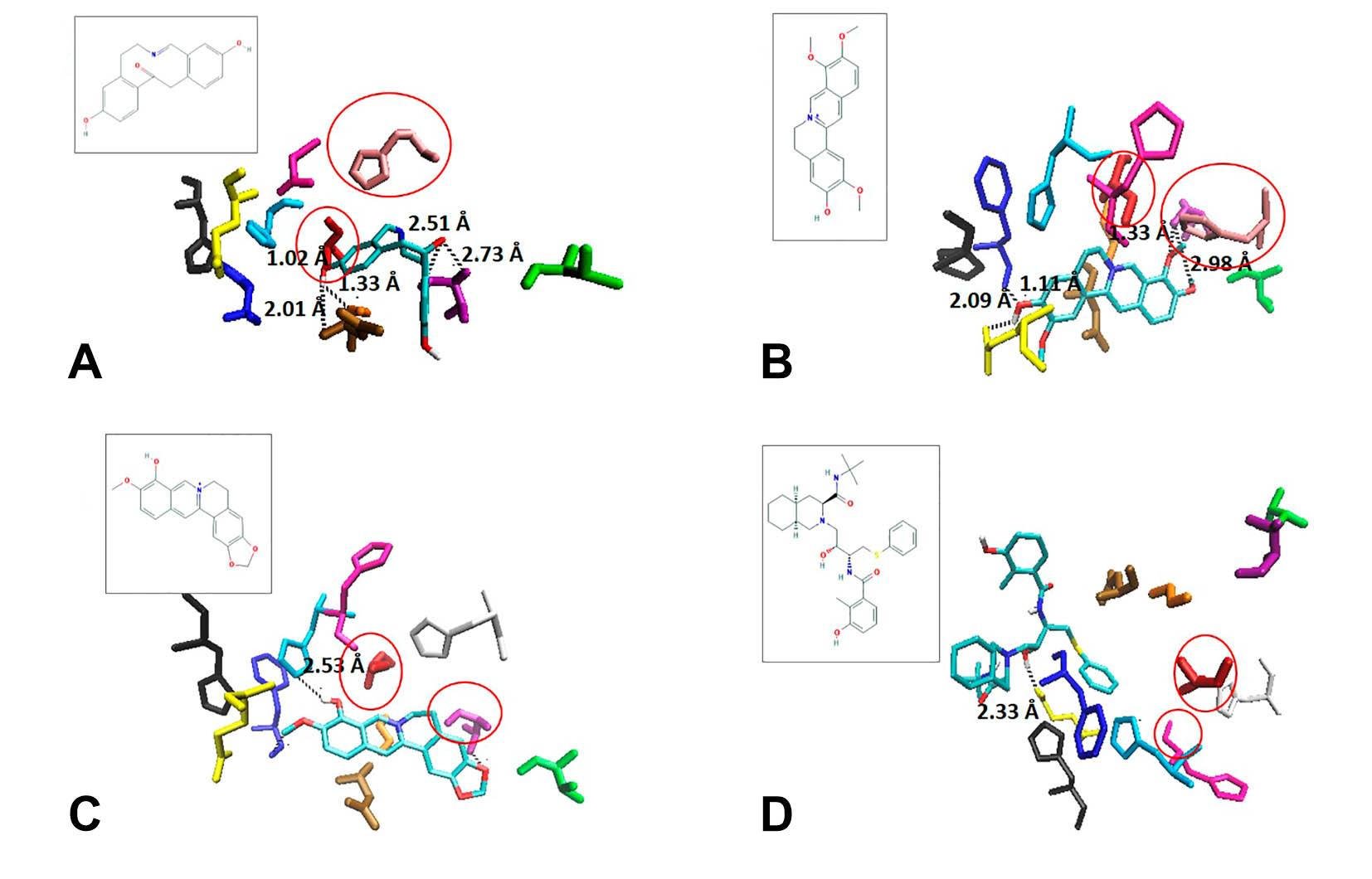
SARS-CoV-2, a new strain of coronavirus (CoV), was identified in Wuhan, China, in 2019, and has been threatening public health worldwide. The aim of this work was to evaluate protoberberine alkaloids compounds of vegetal origin as potential SARS-CoV-2 inhibitors through docking studies. Three key proteins of SARS-CoV-2, recently crystallized, were used as molecular targets: the spike glycoprotein (S), the main protease (Mpro) and the RNA-dependent RNA polymerase (RdRp). Molecular docking was performed using AutoDock, with the Lamarckian Genetic Algorithm, to analyse the probability of docking. The best energy binding values for S protein were, in kcal/mol: -10.67 for Jatrorrhizine, -9.65 for berberine, -9.22 for 5, 6-dihydroconstrictosine. For Mpro, they were, in kcal/mol: -10.15 for 5,6-dihydroconstrictosine, -9.86 for jatrorrhizine, -8.48 for berberubine. Finally, the best binding values for RdRp were, in kcal/mol: -9.04 for belambine, -8.99 for canadine and -8.90 for berberine. Key hydrogen bonds and hydrophobic interactions between protoberberine alkaloids and the respective viral proteins were identified. These results suggest that these alkaloids could potentially be useful as drugs to be experimentally evaluated against COVID-19.
ARK-CAICYT: https://id.caicyt.gov.ar/ark:/s29535441/vrngkarzu
Descargas
Citas
Abbas Zaidi, S., Jameel, S., Jafri, K., Khan, S., & Ahmad, E. (2016). Ilaj bil hijamah (cupping therapy) in the Unani system of medicine: anecdotal practice to evidence-based therapy. Acta Medico-Historica Adriatica, 14(1) 81-94.
Agrawal, A., Jain N. K., Kumar, N., & Kulkarni, G. T. (2020). Molecular Docking Study to Identify Potential Inhibitor of COVID-19 Main Protease Enzyme: An In-Silico Approach. Chem Rxiv. https://doi.org/10.26434/chemrxiv.12170904.v1
Alonso, J. (2008). Tratado de Fitofármacos y Nutracéuticos. (1° Ed). Reimpr.Corpus Ediciones, Rosario, Argentina.
Anand, K., Ziebuhr, J, Wadhwani, P., Mesters, J. R., & Hilgenfeld, R. (2003). Coronavirus main proteinase (3CLpro) structure: Basis for design of anti-SARS drugs. Science, 300, 1763–1767. https://doi.org/10.1126/science.1085658
Bruneton, J. (2001). Farmacognosia, fitoquímica, plantas medicinales. (2° Ed). Editorial ACRIBIA S.A., Argentina.
Camponovo, L., & Bandoni, A. (1995). Farmacología: Materia Médica y Terapéutica. Buenos Aires: López Etchegoyen Libreros Editores, Argentina.
Cecil, C. E., Davis, J. M., Cech, N. B., & Laster, S. M. (2011). Inhibition of H1N1 influenza A virus growth and induction of inflammatory mediators by the isoquinoline alkaloid berberine and extracts of goldenseal (Hydrastis canadensis). International Immunopharmacology, 11(11), 1706-1714. https://doi.org/10.1016/j.intimp.2011.06.002
Cortés Gallardo, V., Macedo Ceja, J., Hernández Arroyo, M., Arteaga Aureoles, G., Espinoza Galván, D., & Rodriguez Landa, J. (2004). Farmacognosia: breve historia de sus orígenes y su relación con las ciencias médicas. Revista Biomedica, 15, 123-136. https://doi.org/10.32776/revbiomed.v15i2.381
Detoc, M., Bruel, S., Frappe, P., Tardy, T., Botelho-Nevers, E., & Gagneux-Brunon, A. (2020). Intention to participate in a COVID-19 vaccine clinical trial and to get vaccinated against COVID-19 in France during the pandemic. Vaccine, 38(45) 7002-7006. https://doi.org/10.1016/j.vaccine.2020.09.041
Devaux, C. A., Rolain, J. M., Colson, P., & Raoult, D. (2020). New insights on the antiviral effects of chloroquine against coronavirus: what to expect for COVID-19. International Journal of Antimicrobial Agents, 55(5):105938. https://doi.org/10.1016/j.ijantimicag.2020.105938
Doublie, S., & Ellenberger, T. (1998). The mechanism of action of T7 DNA polymerase. Current Opinion in Structural Biology, 8(6):704-12. https://doi.org/10.1016/s0959-440x(98)80089-4
Elfiky, A. A., & Ismail A. (2019). Molecular dynamics and docking reveal the potency of novel GTP derivatives against RNA dependent RNA polymerase of genotype 4a HCV. Life Sciences, 238, 116958. https://doi.org/10.1016/j.lfs.2019.116958
Elfiky, A. A., & Elshemey, W. M. (2018). Molecular dynamics simulation revealed binding of nucleotide inhibitors to ZIKV polymerase over 444 nanoseconds, Journal of Medical Virology, 90(1), 13-18. https://doi.org/10.1002/jmv.24934
Elfiky, A. A., & Elshemey, W. M. (2016). IDX-184 is a superior HCV direct-acting antiviral drug: a QSAR study, Medicinal Chemistry Research, 25(5):1005-1008. https://doi.org/10.1007/s00044-016-1533-y
Enkhtaivan, G., Kim, D. H., Park, G. S., Pandurangan, M., Nicholas, D. A., Moon, S.H., Kadam, A.A., Patel, R.V., Shin, H. S., & Mistry, B.M. (2018). Berberine-piperazine conjugates as potent influenza neuraminidase blocker. International Journal of Biological Macromolecules, 119, 12041210. https://doi.org/10.1016/j.ijbiomac.2018.08.047
Ganesan, A., & Barakat, K. (2017). Applications of computer-aided approaches in the development of hepatitis C antiviral agents, Expert Opin. Drug Discovery, 12(4), 407-425. https://doi.org/10.1080/17460441.2017.1291628
Hall, D. C., & Ji, H. F. (2020). A search for medications to treat COVID-19 via in silico molecular docking models of the SARS-CoV-2 spike glycoprotein and 3CL protease. Travel Medicine and Infectious Disease, 35, 101646. https://doi.org/10.1016/j.tmaid.2020.101646
Hilgenfeld, R. (2014). From SARS to MERS: Crystallographic studies on coronaviral proteases enable antiviral drug design. The FEBS Journal., 281, 4085–4096. https://doi.org/10.1111/febs.12936
Hoffmann, M., Kleine-Weber, H., Krüger, N., Müller, M., Drosten, C., & Pöhlmann (2020). The novel coronavirus 2019 (2019-nCoV) uses the SARS-coronavirus receptor ACE2 and the cellular protease TMPRSS2 for entry into target cells. BioRxiv.The preprint server for biology. https://doi.org/10.1101/2020.01.31.929042
Horden, P. and Kukita Yoshikawa, Naoë (2016). Medicine, Religion and Gender in Medieval Culture., 60(3), 441-442. http://library.oapen.org/handle/20.500.12657/29862
Hung, T.-C., Jasse, A., Liu, C.- H., Lin, Ch.-J., Lin, Ch.- Ch., Wong, S. H., Wang, J. Y., Yen, M.- H., & Lin, L.- T. (2018). Berberine inhibits hepatitis C virus entry by targeting the viral E2 glycoprotein. Phytomedicine, 53, 62-69. https://doi.org/10.1016/j.phymed.2018.09.025
Jin, Z., Du, X., Xu, Y., Deng, Y., Liu, M., Zhao, Y., Zhang, B., Li, X., Zhang, L., Peng, C., Duan, Y., Yu, J., Wang, L., Yang, K., Liu, F., Jiang, R., Yang, X., You, T., Liu, X., Yang, X., Bai, F., Liu, H., Liu, X., Guddat, L.W., Xu, W., Xiao, G., Qin, Ch., Shi, Z., Jiang, H.,Rao, X., & Yang, H., (2020). Structure of Mpro from SARS-CoV-2and discovery of its inhibitors. Nature.582, 289-293. https://doi.org/10.1038/s41586-020-2223-y
Joshi, T., Joshi, T., Sharma, P., Mathpal, S., Pundir, H., Bhatt, V., & Chandra, S. (2020). In silico
screening of natural compounds against COVID-19 by targeting Mpro and ACE2 using molecular docking. European Review for Medical and Pharmacological Sciences, 24(8), 4529–4536. https://doi.org/10.26355/eurrev_202004_21036
Joshi, T., Bhat, S., Pundir, H., & Chandra, S. (2021). Identification of Berbamine, Oxyacanthine and Rutin from Berberis asiatica as anti-SARS-CoV-2 compounds: An in silico study. Journal of Molecular Graphics & Modelling, 109, 108028. https://doi.org/10.1016/j.jmgm.2021.108028
Kaur, S. P., & Gupta, V. (2020). COVID-19 Vaccine: A comprehensive status report. Virus Research, 288, 198114. https://doi.org/10.1016/j.virusres.2020.198114.
Khaerunnisa, S., Kurniawan, H., Awaluddin, R., Suhartati, S., & Soetjipto, S. (2020). Potential Inhibitor of COVID-19 Main Protease (Mpro) from Several Medicinal Plant Compounds by Molecular Docking Study. Preprints.org. https://doi.org/10.20944/preprints202003.0226.v1
Kirchdoerfer, R. N., & Ward, A. B. (2019). Structure of the SARS-CoV nsp12 polymerase bound to nsp7 and nsp8 co-factors. Nature communication, 10, 2342. https://doi.org/10.1038/s41467-019-10280-3
Leitao Da-Cunha, E. V., Fechine, I. M., Guedes, D. N., Barbosa-Filho, J. M., & Sobral Da Silva, M. (2005). Protoberberine alkaloids. The Alkaloids, Vol. 62. 75 pp. https://doi.org/10.1016/S1099-4831(05)62001-9
Liu, C., Tang, J., Ma, Y., Liang, X., Yang Y, Peng, G., Qi, Q., Jiang, S., Li, J., Du, L., & Li, F. (2015). Receptor usage and cell entry of porcine epidemic diarrhea coronavirus. Journal of Virology, 89(11), 6121–6125. https://doi.org/10.1128%2FJVI.00430-15
Macchiagodena, M., Pagliali, M., & Procacci, P. (2020). Identification of potential binders of the main protease 3CLpro of the COVID-19 via structure-based ligand design and molecular modeling. Chemical Physics Letters, 750, 137489. https://doi.org/10.1016/j.cplett.2020.137489.
Malika, A. A., McFaddena, S. M., Elharakea, J., & Omera, S. B. (2020). Determinants of COVID-19 vaccine acceptance in the US. EClinicalMedicine, 26, ID 100495. https://doi.org/10.1016/j.eclinm.2020.100495
Morris, G. M., Huey, R., Lindstrom, W., Sanner, M. F., Belew, R. K., Goodsell, D. S., & Olson, A. J. (2009). Software News and Updates. AutoDock4 and AutoDockTools4: Automated Docking with Selective Receptor Flexibility. Journal of Computational Chemistry, 30(16), 2785-2791. https://doi.org/10.1002/jcc.21256
Qin, Q.- P., Zou, B.-Q., Wang, Z.- F., Huang, X.- L., Zhang, Y., Tan, M.- X., Wang, S.- L., & Liang, H. (2019). High in vitro and in vivo antitumor activities of luminecent platinum (II) complexes with jatrorrhizine derivative. European Journal of Medicinal Chemistry, 183, 111727. https://doi.org/10.1016/j.ejmech.2019.111727
Rastrelli, L., Capasso, A., Pizza, C., De Tommasi, N., & Sorretino, L. (1997). New Protopine and Benzyltetrahydroprotoberberine Alkaloids from Aristolochia constricta and Their Activity on Isolated Guinea-Pig Ileum. Natural Products 60,11, 1065-1069. https://doi.org/10.1021/np960710b
Roy, A., & Saraf, S. (2006). Limonoids: overview of significant bioactive triterpenes distributed in plants kingdom. Biological and Pharmaceutical Bulletin, 29(2), 191-201. https://www.jstage.jst.go.jp/article/bpb/29/2/29_2_191/_pdf
Sharapin, N., Machado, L., Souza, E., de Albuquerque, E., Valverde, E., & López, J. M. (2000). Fundamentos de tecnología de productos fitoterapéuticos. Santa Fe de Bogotá, Convenio Andrés Bello y Red Iberoamericana de Productos Fitofarmacéuticos (RIPROFITO) del subprograma X de CYTED. Pp 248. España.
Shin, H.-B., Choi, M.-S., Yi, C.-M., Lee, J., Kim, N.-J., & Inn, K.-S. (2015). Inhibition of respiratory syncytial virus replication and virus-induced p38 kinase activity by berberine. International Immunopharmacology, 27, 6568. http://dx.doi.org/10.1016/j.intimp.2015.04.045
Sun, Y., Gao, X., Wu, P., Wink, M., Li, J., Dian, L., & Lian, Z. (2019). Jatrorrhizine inhibits mammary carcinoma cells by targeting TNIK mediated Wnt/β-catenin signalling an depithelial-mesenchymal transition (EMT). Pythomedicine, 63,153015. https://doi.org/10.1016/j.phymed.2019.153015
Tallei, T. E., Tumilaar, S. G., Niode, N. J., Fatimawali, Kepel, B. J., Idroes, R., Effendi, Y., Sakib, S.A., & Emran, T. B. (2020). Potential of Plant Bioactive Compounds as SARS-CoV-2 Main Protease (Mpro) and Spike (S) Glycoprotein Inhibitors: A Molecular Docking Study. Scientifica, ID 6307457. https://doi.org/10.1155/2020/6307457
Venkateshan, M., Muthu, M., Suresh, J., & Ranjith Kumar, R. (2020). Azafluorene derivatives as inhibitors of SARS CoV-2 RdRp: Synthesis, physicochemical, quantum chemical, modeling and molecular docking analysis. Journal of Molecular Structure, 1220, 128741. https://doi.org/10.1016/j.molstruc.2020.128741
Walls, A. C., Tortorici, M. A., Bosch, B. J., Frenz, B., & Rottier, P. J. (2016). Cryo-electron microscopy structure of a coronavirus spike glycoprotein trimer. Nature, 531, 114–117. https://www.nature.com/articles/nature16988
Wang, W. J., Yang, T., Chen, H., Xu, Y. N., Yu, L. F., Liu, T., Tang, J., Yi, Z., Yang, C.G., Xue, W., & Yang, F. (2017). The synthesis and antistaphylococcal activity of 9, 13-disubtituted berberine derivatives. European Journal of Medicinal Chemistry, 127,424-433. https://doi.org/10.1016/j.ejmech.2017.01.012
White, N. J., Pukrittayakamee, S., Hien, T. T., Faiz, M. A., Mokuolu, O. A., & Dondorp, A. M. (2014) Malaria. Lancet, 383:723–35.
Wrapp, D., Wang, N., Corbett, K. S., Goldsmith, J. A., Hsieh, C. L., Abiona, O., Graham, B. S., & McLellan, J. S. (2020). Cryo-EM structure of the 2019-nCoV spike in the prefusion conformation. Science, 367(6483), 1260-1263. http://dx.doi.org/10.1126/science.abb2507
Wu, F., Zhao, S., Yu, B., Chen, Y.-M., Wang, W., Song, Z.-G., Hu, Y., Tao, Z. W., Tian, J.-H., Pei, Y.-Y., Yuan, M.-L., Zhang, Y.-L., Dai, F.-H., Liu, Y., Wang, Q.-M., Zheng, J.-J., Xu, L., Holmes, E. C., & Zhang, Y.-Z. (2020). A New coronavirus associated with human respiratory disease in China. Nature, 579, 265–269. https://doi.org/10.1038/s41586-020-2008-3
Wu, H., Heb, K., Wang, Y. Z., Xue, D. F., Ning, N., Zou, Z., Ye, X., Li, X., Wang, D. Z., & Pan, J. (2014). The antihypercholesterolemic effect of jatrorrhizine is olated from Rhizoma Coptidis. Phytomedicine. https://doi.org/10.1016/j.phymed.2014.05.002
Yang, L., Wen, K.S., Ruan, X., Zhao, Y. X., Wei, F., & Wang, Q. (2018). Response of plant secondary metabolites to environmental factors. Molecules, 23(4), 762. https://doi.org/10.3390/molecules23040762
Zhang, L., Lin, D., Sun, X., Curth, U., Drosten, C., Sauerhering, L., Becker, S., Rox, K., & Hilgenfeld, R. (2020). Crystal structure of SARS-CoV-2 main protease provides a basis for design of improved α-ketoamide inhibitors. Nature. http://dx.doi.org/10.1038/s41586-020-2223
Zhou, P., Yang, X.L., Wang, X. G., Hu, B., Zhang, L., Zhang, W., Si, H. R., Zhu, Y., Li, B., Huang, C. L., Chen, H. D., Chen, J., Luo, Y., Guo, H., Jiang, R. D., Liu, M. Q., Chen, Y., Shen, X. R., Wang, W., Zheng, X. S., Zhao, K., Chen, Q. J., Deng, F., Liu, L. L., Yan, B., Zhan, F. X., Wang, Y. Y., Xiao, G. F., & Shi, Z. L. (2020). A. Pneumonia outbreak associated with a new coronavirus of probable bat origin. Nature, 579, 270–273. https://doi.org/10.1038/s41586-020-2012-7
Publicado
Cómo citar
Número
Sección
Licencia
Derechos de autor 2024 María A. Zigolo

Esta obra está bajo una licencia internacional Creative Commons Atribución-NoComercial-CompartirIgual 4.0.