


Validation and Updating of Shrub and Tree Species of the Asteraceae Family of Salta (Argentina): Key for their Morphological Recognition
Keywords:
Compositae, Flora de Salta, Morfología de capítulosAbstract
Within the Asteraceae family, shrubby and tree-like species have great ecological value in the province of Salta. Many of its traditional groupings have been significantly estructured based on recent morphological and phylogenetic studies. A notable example is the former tribe Mutisieae, whose polyphyletic nature led to its genera being reassigned to different subfamilies. This study aims to characterise representatives of the Gochnatioideae, Mutisioideae and Stifftioideae in the central intermontane region of Salta by
providing morphological information on their vegetative and reproductive structures, in the context of current phylogenetic classifications. The methodology consisted of detailed morphological observations, herbarium specimen analysis, and the inclusion of pertinent literature review of the species of Aphyllocladus spartioides, Cnicothamnus lorentzii, Dinoseris salicifolia, Gochnatia palosanto, Mutisia acuminata var. paucijuga, Mutisia kurtzii var. anomala, Pentaphorus glutinosus, Proustia cuneifolia subsp. cuneifolia and Trixis grisebachii. The morphological descriptions of diagnostic floral characters (capitulum, phyllaries, and corolla) have therefore been expanded, and new records have been incorporated, extending the known
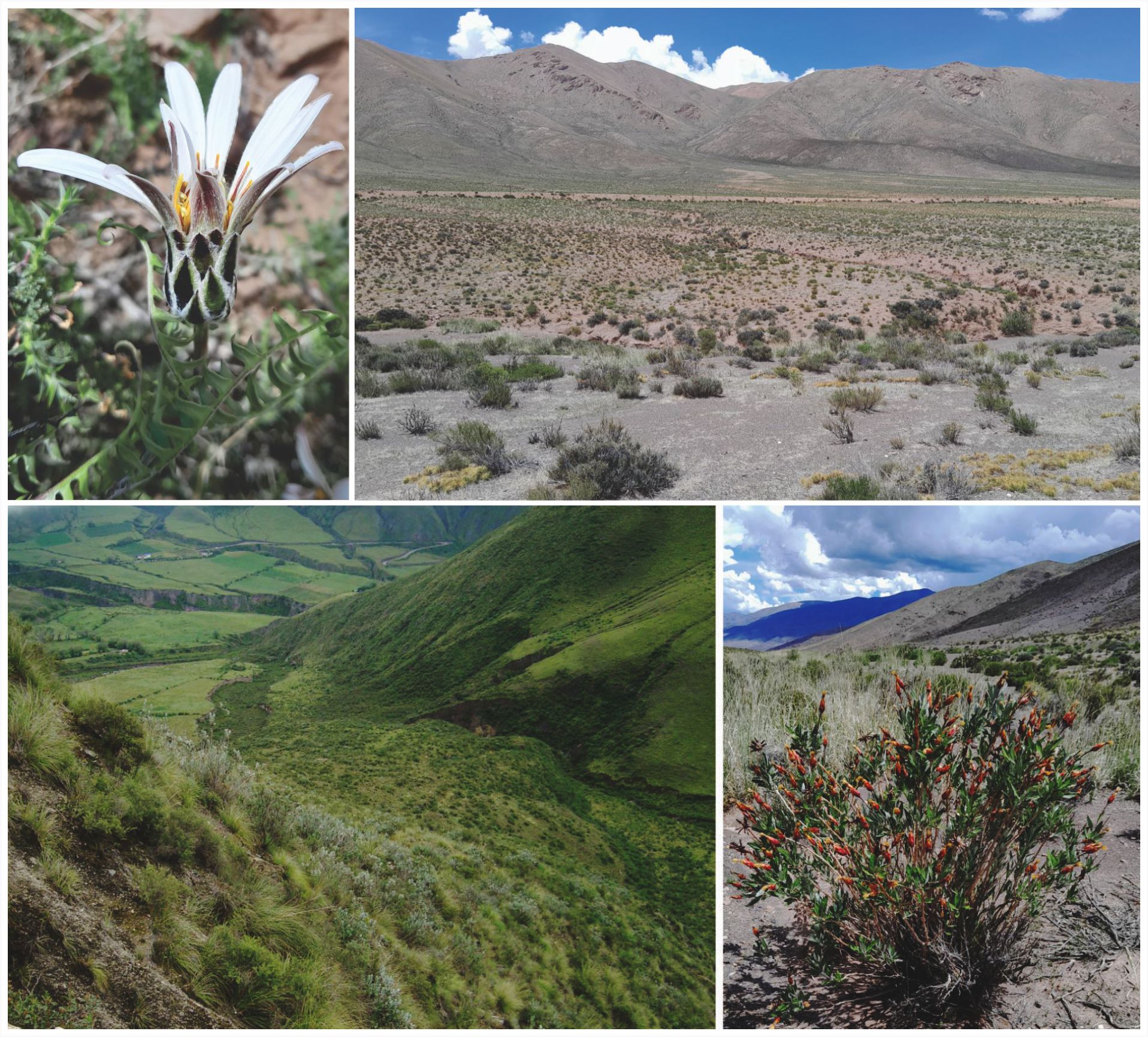
geographic distribution of the species. Notably, Hyaloseris rubicunda and Mutisia hamata have been included as new records for the region. The study includes photographic illustrations and a dichotomous key for identifying the taxa.
ARK-CAICYT: https://id.caicyt.gov.ar/ark:/s29535441/rz5pwcd25
Downloads
References
Ariza Espinar, L. (1973). Notas sobre algunas especies de Mutisieae (Compositae) de Argentina. Lilloa, 33(1), 157-171.
Bentham, G. & Hooker, J. D. (1873). Compositae. En G. Bentham & J. D. Hooker (Eds.), Genera plantarum, Vol. 2, Fasc. 1, pp.163-533. Lovell Reeve & Co. London.
Bremer, K. (1987). Tribal interrelationships of the Asteraceae. Cladistics, 3, 210-253.
Bremer, K. & Jansen, R. K. (1992). A new subfamily of the Asteraceae. Annals of the Missouri Botanical Garden, 79, 414-415.
Bremer, K. (1994). Asteraceae Cladistics and Classification. Timber Press. EEUU.
Bremer, K. (1996). Major clades and grades of the Asteraceae. En D. J. N. Hind & H. J. Beentje (Eds.), Compositae: Systematics. Proceedings of the International Compositae Conference, Kew, 1994, Vol. 1, pp.1–7. Royal Botanic Gardens. Londres.
Cabrera, A. L. (1935). Contribución al estudio de las Compuestas argentinas. Revista del Museo de La Plata, Sección Botánica, 1(1), 1-96.
Cabrera, A. L. (1951). Notas sobre Compuestas de la América austral. Darwiniana, 9(3- 4), 363-386.
Cabrera, A. L. (1963). Compositae. En A. L. Cabrera (Ed.), Flora de la Provincia de Buenos Aires, Vol. 4, pp. 1-443. Colección Ciencias del Instituto Nacional de Tecnología Agropecuaria. Buenos Aires.
Cabrera, A. L. (1965). Revisión del género Mutisia (Compositae). Opera Lilloana, 13,1-227.
Cabrera, A. L. (1977). Mutisieae-Systematic review. En V. H. Heywood, J. B. Harborne & B. L. Turner (Eds.), The biology and chemistry of the Compositae, Vol. 2, pp. 1039-1066. Academic Press. London.
Cabrera, A. L. (1978). Compositae. En A.Cabrera (Ed.), Flora de la Provincia de Jujuy, Vol. 10, pp. 1-726. Colección Ciencias del Instituto Nacional de Tecnología Agropecuaria. Buenos Aires.
Calderón, A. I., Vázquez, Y., Solís, P. N., Caballero- George, C., Zacchino, S., Gimenez, A., Pinzon, R., Cáceres, A., Tamayo, G., Correa, M., & Gupta, M. P. (2006). Screening of Latin American plants for cytotoxic activity. Pharmaceutical Biology, 44(2), 130–140. https://doi.org/10.1080/13880200600592285
Calderón, A. I., Romero, L., Ortega-Barría, E., Solís, P. N., Zacchino, S., ... & Gupta, (2009). Screening of Latin American plants for antiparasitic activities against malaria, Chagas disease, and leishmaniasis. Pharmaceutical Biology, 48(5), 545–553. https://doi.org/10.3109/13880200903193344
Cassini, H. (1819). Sixième mémoire sur la famille des synanthérées, contenant les caractères des tribus. Journal de Physique, de Chimie, d’Histoire Naturelle et des Arts, 88, 150– 163, 189–204.
Carlquist, S. (1976). Trichome morphology and the classification of Asteraceae. Biological Journal of the Linnean Society, 8, 319-336.
Dimitri, M. J. (1972). Enciclopedia Argentina de Agricultura y Jardinería Vol. 1. Descripción de Plantas Cultivadas (2.ª Ed.). ACME. Argentina.
Erbar C. (2015). Bi- to multi-seriate stylar hairs in Eremothamneae, Oldenburgieae, Stifftieae, and Wunderlichieae (Asteraceae). Systematic Botany, 40(4), 1144-1158. https://doi. org/10.1600/036364415X690166
Erbar, C. (2016). Unique style morphology in the monotypic Famatinanthoideae– Famatinantheae, a recently established subfamily and tribe of Asteraceae. Systematic Botany, 41(3), 796-806. https://doi. org/10.1600/036364416X692415
Fabris, H. A. (1968). Revisión del género Proustia (Compositae). Revista del Museo de La Plata, Nueva Serie, Sección Botánica, 11(51– 65), 23-49.
Freire, S. E., Katinas, L., & Sancho, G. (2002). Gochnatia (Asteraceae, Mutisieae) and the Gochnatia complex: Taxonomic implications from morphology. Annals of the Missouri Botanical Garden, 89, 524–550.
Freire, S. E. (2015). Tribu Mutisieae Cass. En F. O. Zuloaga, M. J. Belgrano & A. M. Anton (Eds.), Flora Argentina: Flora vascular de la República Argentina: Dicotyledoneae; Asteraceae: Cichorieae, Helenieae a Mutisieae, Vol. 7, Tomo II, pp. 298-486. Estudio Sigma S.R.L. Buenos Aires.
Fuentes-Lillo, E., Cuba-Díaz, M., Troncoso- Castro, J. M., & Rondanelli-Reyes, M. (2017). Seeds of non-native species in King George Island soil. Antarctic Science, 29(4), 324-330. https://doi.org/10.1017/S0954102017000037
Funk, V. A., Randall, J. B., Keeley, S. C., Chan, R., Watson, L., Gemeinholzer, B., Schilling, E., Panero, J. L., Baldwin, B. G., García-Jacas, N., Susanna, A. & Jansen, R. K. (2005). Everywhere but Antarctica: Using a supertree to understand the diversity and distribution of the Compositae. Biologiske Skrifter, 55, 343-373.
Funk, V. A., Susanna, A., Stuessy, T. F. & Bayer, R. J. (2009). Systematics, Evolution, and Biogeography of Compositae. International Association for Plant Taxonomy. Austria.
Funk, V. A., Sancho, G., Roque, N., Kelloff, C. L., Ventosa-Rodríguez, I., Diazgranados, M., Bonifacino, J. M., & Chan, R. (2014). A phylogeny of the Gochnatieae: Understanding a critically placed tribe in the Compositae, Taxon, 63(4), 859-882. https://doi. org/10.12705/634.27
Fuentes-Lillo, E., Cuba-Díaz, M., Troncoso-Castro, J. M., & Rondanelli-Reyes, M. (2017). Seeds of non-native species in King George Island soil. Antarctic Science, 29(4), 324–330. https://doi.org/10.1017/S0954102017000037
Gostel, M. R., Sancho, G., Roque, N., Donato, M., & Funk, V. A. (2022). Phylogenomic loci define the generic boundaries of Gochnatieae and improve resolution at the species level in Moquiniastrum (Compositae). Molecular Phylogenetics and Evolution, 175, 107558. https://doi.org/10.1016/j.ympev.2022.107558
Hieronymus, J. (1882). Plantae Diaphoricae Florae Argentinae. G. Kraft. Argentina.
Hind, D. J. N. (2007). Tribe Mutisieae. En J. W. Kadereit & C. Jeffrey (Eds.), Families and genera of vascular plants, Vol. 8, pp.87–391. Springer. Berlin & Heidelberg.
Hurrell, J. A., Bayón, N. D., & Delucchi, G. (2017). Plantas Cultivadas de la Argentina: Asteráceas-Compuestas. Hemisferio Sur. Argentina.
Jansen, R. K, Palmer J. D. (1987). A chloroplast DNA inversion marks an ancient evolutionary split in the sunflower family (Asteraceae). Proceedings of the National Academy of Sciences, 84(16), 5818-5822. https://doi. org/10.1073/pnas.84.16.5818
JSTOR. (Acceso: 4 de agosto de 2025). JSTOR Global Plants. https:// plants.jstor.org/ collection/
Jeffrey, C. (2007). Introduction with key to tribes. En J. W. Kadereit & C. Jeffrey (Eds.), The families and genera of vascular plants, Vol. 8, pp.61–87. Springer. Berlín & Heidelberg.
Katinas, L.(1996).Asteraceae,Tribu XII. Mutisieae. Subtribu 3. Mutisiinae. En A. T. Hunziker (Ed.), Flora Fanerogámica Argentina, Fasc. 29, pp.1-40. International Association for Plant Taxonomy. Viena &Austria.
Katinas, L., Pruski, J. F., Sancho, G., & Tellería, M. C. (2008). The Subfamily Mutisioideae (Asteraceae). The Botanical Review, 74(4), 469-716.
Katinas, L., Sancho, G., Tellería, M. C. & Crisci, J. V. (2009). Mutisieae sensu stricto (Mutisioideae sensu stricto). En V. A. Funk, A. Susanna, T. F. Stuessy, R. Bayer (Eds.), Systematics, evolution and biogeography of the Compositae, Cap. 14, pp.229-248. International Association for Plant Taxonomy. Viena &Austria.
Katinas, L. & Funk, V. A. (2020). An updated classification of the basal grade of Asteraceae (= Compositae): from Cabrera’s 1977 tribe Mutisieae to the present, New Zealand Journal of Botany, 58(2), 67-93. https://doi.or g/10.1080/0028825X.2020.1718168
Latzina, E. (1937). Index de la Flora Dendrológica Argentina. Lilloa, 1, 95–211.
Leal, M., Mercado, M. I., Moreno, M. A., Martínez Chamas, J. J., Zampini, I. C., Ponessa, G. I., Simirgiotis, M. J., & Isla, M. I. (2023). Gochnatia glutinosa (D.Don) D.Don ex Hook. & Arn.: A plant with medicinal value against inflammatory disorders and infections. Heliyon, 9, e15276. https://doi.org/10.1016/j. heliyon.2023.e15276
Lindley, J. (1829). Mutisioideae. En J. Loudon (Ed.), An Encyclopaedia of Plants, pp.1072- 1074. Longman, Rees, Orme, Brown and Green. Londres.
Mandel, J. R., Dikow, R. B. & Funk, V. A. (2015). Using phylogenomics to resolve mega- families: An example from Compositae. Journal of Systematics and Evolution, 53(5), 391-402. https://doi.org/10.1111/jse.12167
Mandel, J. R., Barker, M., Bayer, R. J., Dikow, R., Gao, T.-G., Jones, K., Keeley, S., Kilian, N., Ma, H., Siniscalchi, C., Susanna, A., Watson, L., Thapa, R. & Funk, V. A. (2017). The Compositae Tree of Life in the age of phylogenomics. Journal of Systematics and Evolution, 55(5), 405–430. https://doi. org/10.1111/jse.12265
Mandel, J. R., Dikow, R. B., Siniscalchi, C. M., Thapa, R., Watson, L. E. & Funk, V. A. (2019). A fully resolved backbone phylogeny reveals numerous dispersals and explosive diversifications throughout the history of Asteraceae. Proceedings of the National Academy of Sciences, 116(28), 14083-14088. https://doi.org/10.1073/pnas.1903871116
Miller, R. M. (1970). A new species of Proustia and a synopsis of the genus. Rhodora, 72(789), 112-117.
Moreira-Muñoz, A., Monge, M., Grossi, M. A., Ávila, F. A., Morales-Fierro, ... & Gutiérrez, D. G. (2024). South America holds the greatest diversity of native daisies (Asteraceae) in the world: An updated catalogue supporting continental-scale conservation. Frontiers in Plant Science, 15, 1393241. https://doi. org/10.3389/fpls.2024.1393241
Muñoz Schick, M. (1971). Tipos de plantas descritas por Karl Reiche, conservados en el Museo Nacional de Historia Natural. Boletín del Museo Nacional de Historia Natural Chile, 32, 377–393.
Novara, J. L, Katinas, L. & Urtubey, E. (1995). Asteraceae Tribu 10 Mutisieae. En L. J.Novara (Ed.), Aportes Botánicos de Salta-Ser Flora, Vol. 3, pp.1-86.
Panero J. L. & Funk VA. (2002). Toward a phylogenetic subfamilial classification for the Compositae (Asteraceae). Proceedings of the Biological Society of Washington, 115, 909-922.
Panero, J. L. & Funk, V. A. (2007). New infrafamilial taxa in Asteraceae. Phytologia, 89(3), 356-360.
Panero, J. L. & Funk, V. A. (2008). The value of sampling anomalous taxa in phylogenetic studies: Major clades of the Asteraceae revealed. Molecular Phylogenetics and Evolution, 47(2), 757-782.
Panero, J. L., Freire, S. E., Ariza Espinar, L., Crozier, B. S., Barboza, G. E., & Cantero, J. J. (2014). Resolution of deep nodes yields an improved backbone phylogeny and a new basal lineage to study early evolution of Asteraceae. Molecular Phylogenetics and Evolution, 80, 43–53. https://doi. org/10.1016/j.ympev.2014.07.012
Peña, N. I. (1928). Flora Económica de la Provincia de Salta. Universidad de Buenos Aires. Argentina.
Pruski, J. F. & Sancho, G. (2004). Asteraceae o Compositae. En N. P. Smith, S. V. Heald, A. Anderson, S. A. Mori & D. W. Stevenson (Eds.), Flowering plants of the Neotropics, pp.33-39. Princeton University Press. Princeton.
Roque, N., & Funk, V. A. (2013). Morphological characters add support for some members of the basal grade of Asteraceae. Botanical Journal of the Linnean Society, 171, 568-586. https://doi.org/10.1111/boj.12000
Ruiz, A. I., Guantay, M. E., Mercado, M. I., & Ponessa, G. I. (2014). Cnicothamnus lorentzii (Asteraceae): morfoanatomía y arquitectura foliar. Lilloa, 51(2), 226-235.
Ruiz, A. I., Mercado, M. I., Guantay, M. E., & Ponessa, G. I. (2016). Arquitectura y morfoanatomía foliar de Dinoseris salicifolia (Asteraceae). Lilloa, 53(1), 112-121.
Sánchez, M. E., De Gracia, J. N., & Quiroga Mendiola, M. (2015). Guía visual de plantas nativas del Parque Nacional Los Cardones: Valles Calchaquíes, Salta, Argentina. Administración de Parques Nacionales.
Sancho, G., & Freire, S. E. (2009). Gochnatieae (Gochnatioideae) and Hyalideae (Wunderlichioideae p.p.). En V. A. Funk, A. Susanna, T. Stuessy, & R. Bayer (Eds.), Systematics, evolution and biogeography of Compositae, pp.249-265. International Association for Plant Taxonomy. Viena & Austria. Sancho, G., Katinas, L., Viera Barreto, J. N., Moreira-Muñoz, A., & Luebert, F. (2018). Phylogenetic relationships and generic reassessment of Proustia and allies (Compositae: Nassauvieae). Taxon, 67(1), 113–129.
Susanna, A., Baldwin, B. G., Bayer, R. J., Bonifacino, J. M., Garcia-Jacas, N., Keeley, S. C., Mandel, J. R., Ortiz, S., Robinson, H., & Stuessy, T. F. (2020). La clasificación de los Compositae: Un homenaje a Vicki Ann Funk (1947–2019). Taxon, 69(4), 807–814. https://doi.org/10.1002/tax.12235
Tellería, M. C., Urtubey, E. & Katinas, L. (2003). Proustia and Lophopappus (Asteraceae, Mutisieae): generic and subtribal relationships based on pollen morphology. Review of Palaeobotany and Palynology, 123, 237-246.
Thiers B. (Acceso: 29 de octubre de 2025). Index Herbariorum: A global directory of public herbaria and associated staff. New York Botanical Garden’s Virtual Herbarium. http:// sweetgum.nybg.org/science/ih
Tortoni, G. L., Arias Toledo, B., & Vignale, N. D. (2021). La flora medicinal andina en las preparaciones tradicionales de la comunidad de Ocumazo (Pueblo Omaguaca), Jujuy, Argentina. Boletín de la Sociedad Argentina de Botánica, 56(3), 403-417. https://doi. org/10.31055/1851.2372.v56.n3.32953
TROPICOS. (Acceso: 11 de agosto de 2025). Tropicos. org. Missouri Botanical Garden. http://www.tropicos.org
Turland, N. J., Wiersema, J. H., Barrie, F. R., Gandhi, K. N., Gravendyck, J., Greuter, W., Hawksworth, D. L., Herendeen, P. S., Klopper, R. R., Knapp, S., Kusber, W.-H., Li, D.-Z., May, T. W., Monro, A. M., Prado, J., Price, M. J., Smith, G. F. & Zamora Señoret, J. C. (2025). Código Internacional de Nomenclatura para algas, hongos y plantas (Código de Madrid). Regnum Vegetabile 162. University of Chicago Press. EEUU https://doi.org/10.7208/ chicago/9780226839479.001.0001
Vignale, N. D., & Gurni, A. A. (1999). Estudio comparativo de la epidermis foliar de tres especies de Mutisia (Asteraceae) de la Puna y Prepuna de Jujuy (Argentina). Acta Farmacéutica Bonaerense, 18(1), 37-40.
Vito, M., Pigni, N., Gianello, J. C., & Tonn, C. E. (1997). Composición química y propiedades antimicrobianas de Gochnatia glutinosa. Acta Farmacéutica Bonaerense, 16(1), 17-21.
Additional Files
Published
How to Cite
Issue
Section
License

This work is licensed under a Creative Commons Attribution-NonCommercial-ShareAlike 4.0 International License.