


Epífitos Vasculares sobre Diez Forófitos de las Yungas del Noroeste Argentino, con Énfasis en Helechos
Palabras clave:
Bosque Nublado, Forófitos, Polypodiaceae, YungasResumen
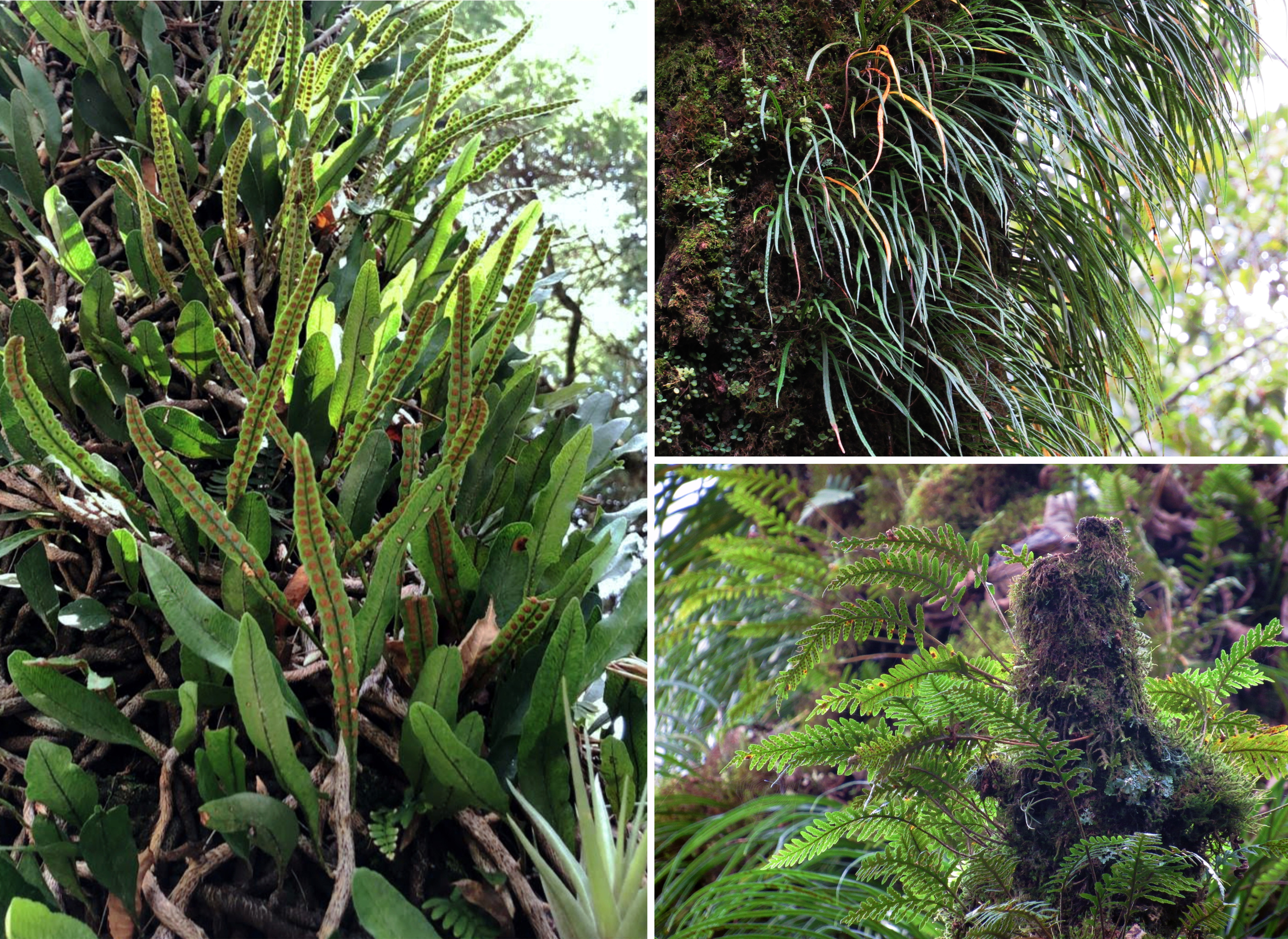
Las epífitas vasculares son componentes clave en la riqueza de especies de los bosques tropicales húmedos, donde contribuyen significativamente a la biodiversidad y a la estructura del ecosistema. El objetivo de este estudio fue evaluar la diversidad de epífitos vasculares asociadas a diez especies de forófitos en la región biogeográfica de las Yungas, en el noroeste de Argentina. Se muestrearon entre cinco y diez individuos por especie de forófito, con un diámetro a la altura del pecho (DAP) superior a 30 cm, en cinco localidades: La Caldera (camino de cornisa), Parque Nacional Calilegua, Potrero de Yala, Quebrada de San Lorenzo y Tiraxi. En total, se registraron 47 especies de epífitas, de las cuales 18 correspondieron a helechos. La familia Polypodiaceae presentó la mayor diversidad de helechos epífitos. Las especies más frecuentes en los forófitos muestreados fueron Campyloneurum aglaolepis, Microgramma squamulosa y Pleopeltis tweedieana. Los forófitos que albergaron la mayor diversidad epifítica fueron Cedrela angustifolia, Tipuana tipu, Erythrina falcata y Ocotea porphyria, mientras que Nectandra angustifolia y Zanthoxylum coco presentaron la menor diversidad. Además, se observó que el 76 % de las epífitas habitan predominantemente en la copa interna de los forófitos.
ARK CAICYT: https://id.caicyt.gov.ar/ark:/s29535441/ouar2ujxm
Descargas
Citas
Barrington, D. S. (1993). Ecological and histo- rical factors in fern biogeography. Journal of Biogeography, 20, 275-280. https://doi. org/10.2307/2845635
Barthlott, W., Schmith-Neuerburg V., Nieder J., & Engwald, S. (2001). Diversity and abundance of vascular epiphytes: a comparision of a secondary vegetation and primary montane rainforest in the Venezuelan Andes. Plant Ecology, 152, 145-156. https://doi. org/10.1023/A:1011483901452
Benzing, D. H. (1990). Vascular Epiphytes Cambridge University Press. Cambridge. Journal of tropical ecology, 12, 354.
Bonnet, A., Curcio, G. R., Lavoranti, O. J., & Galvão, F. (2011). Flora epifítica vascular em três unidades vegetacionais do Rio Tibagi, Paraná, Brasil. Rodriguésia, 62(3), 491-498. https://doi.org/10.1590/2175-7860201162305
Brown, A. D. (1990). El epifitismo en las selvas montanas del Parque Nacional “El Rey”, Argentina: Composición florística y patrón de distribución. Revista de Biología Tropical, 38 (2A), 155-166. https://archivo.revistas.ucr. ac.cr/index.php/rbt/article/view/25037
Brown, A. D. & Kappelle, M. (2001). Introducción a los bosques nublados del neotrópico: una síntesis regional. En M. Kappelle, & D. Brown (Eds.), Bosques nublados del neotrópico (pp. 25-40). Instituto Nacional de Biodiversidad (INBio), IMBIO, Santo Domingo de Heredia, Costa Rica.
Brown, A. D., Grau, A., Lomáscolo, T., & Gasparri, N. I. (2002). Una estrategia de conservación para las selvas subtropicales de montaña (Yungas) de Argentina. Ecotropicos, 15(2), 147-159.
Cabrera, A., & Willink, A. (1980). Biogeografía de América Latina. Secretaría General de la Organización de los Estados Americanos. Programa Regional de Desarrollo Científico y Tecnológico. Serie de Biología. Monografía, (13).
Ceballos, S. J., Chacoff, N. P., & Malizia, A. (2016). Interaction network of vascular epiphytes and trees in a subtropical forest. Acta Oecologica, 77, 152-159. https://doi. org/10.1016/j.actao.2016.10.007
Ceballos, S. J. (2023). Vascular epiphytes in Argentinian Yungas: distribution, diversity, and ecology. The Botanical Review, 89, 91-113. https://doi.org/10.1007/s12229-
-09281-7
Cortés-Anzúres, B. O., Corona-López, A. M., Damon, A., Mata-Rosas, M., & Flores- Palacios, A. (2020). Phorophyte type determines epiphyte-phorophyte network structure in a Mexican oak forest. Flora, 272, 151704. https://doi.org/10.1016/j. flora.2020.151704
de la Sota, E. R. (1971). El epifitismo y las pteridofitas en Costa Rica (América Central). Nova Hedwigia, 21, 401-465.
Gentry, A. H., & Dodson, C. H. (1987). Diversity and biogeography of Neotropical vascular epiphytes. Annals of the Missouri Botanical Garden, 74, 205-233. https://doi. org/10.2307/2399395
Hernández-Rosas, J. (2001). Ocupación de los portadores por epífitas vasculares en un bosque húmedo tropical del Alto Orinoco, Edo. Amazonas, Venezuela. Acta Científica Venezolana, 52, 292-303.
Hernández-Rosas, J. (2004). Características del substrato de plantas del dosel de un bosque húmedo tropical de tierras bajas (Alto Orinoco, Venezuela). Acta Científica Venezolana, 55, 35-43.
Hietz, P., & Briones, O. (1998). Correlation between water relations and within-canopy distribution of epiphytic ferns in a Mexican cloud forest. Oecologia, 114, 305-316. https:// doi.org/10.1007/s004420050452
Hirata, A., Kamijo, T., & Saito, S. (2008). Host trait preferences and distribution of vascular epiphytes. In Van der. Valk (Ed.), Forest Ecology. Springer, Dordrecht.
Hofstede, R. G., Wolf, J. H., & Benzing, D. H. (1993). Epiphytic biomass and nutrient status of a Colombian upper montane rain forest. Selbyana, 14, 37-45.
Ibisch, P. L., Boegner A., Nieder, J., & Barthlott, W. (1996). How diverse are Neotropical epiphytes? An analysis based on the “Catalogue of the Flowering Plants and Gymnosperms of Peru”. Ecotropica, 2, 13-28.
Johansson, D. (1974). Ecology of vascular epiphytes in West African rain forest. Acta Phytogeographica Suecica, 59, 1-136.
Kersten, R. A. (2010). Epífitas vasculares– Histórico, participação taxonômica e aspectos relevantes, com ênfase na Mata Atlântica. Hoehnea, 37(1), 9-38. https://doi.org/10.1590/ S2236-89062010000100001
Krömer, T., Kessler, M., Gradstein, S. R., & Acebey,
A. (2005). Diversity patterns of vascular epiphytes along an elevational gradient in the Andes. Journal of Biogeography, 32, 1799-1809. https://doi.org/10.1111/j.1365- 2699.2005.01318.x
Krömer, T., Kessler, M., & Gradstein, S. R. (2007). Vertical stratification of vascular epiphytes in submontane and montane forest of the Bolivian Andes: the importance of the understory. Plant Ecology, 189, 261-278. https://doi.org/10.1007/s11258-006-9182-8
Laube, S., & Zotz, G. (2006). Neither host-specific nor random: vascular epiphytes on three tree species in a Panamanian lowland forest. Annals of Botany, 97(6), 1103-1114. https:// doi.org/10.1093/aob/mcl067
Malizia, A. (2003). Host tree preference of vascular epiphytes and climbers in a subtropical montane cloud forest of northwest Argentina. Selbyana, 24, 196-205. https://www.jstor.org/ stable/41760133
Martín, J. S., Espinosa, A., Zanetti, S., Hauenstein, E., Ojeda, N., & Arriagada, C. (2008). Composición y estructura de la vegetación epífita vascular en un bosque primario de Olivillo (Aextoxicon punctatum R. et P.) en el sur de Chile. Ecología Austral, 18,1-11.
Raghavan, V. (1989). Developmental Biology of Ferns. Pp.331. Cambridge Press.
RStudio Team. (2025). RStudio: Integrated Development for R. RStudio, PBC, Boston, MA.
Sugden, A. M., & Robins, R. J. (1979). Aspects of the ecology of vascular epiphytes in Colombian could forests, I. The distribution of the epiphytic flora. Biotropica 11(3), 173- 188. https://doi.org/10.2307/2388037
Tryon, R. M. (1986). The biogeography of species, with special reference to ferns. Botanical Review, 52, 117-156. https://doi.org/10.1007/ BF02860999
Wagner, K., Mendieta-Leiva, G., & Zotz, G. (2015). Host specificity in vascular epiphytes: a review of methodology, empirical evidence and potential mechanisms. AoB plants, 7, plu092. https://doi.org/10.1093/ aobpla/plu092
Wolf, J. H. D. (1993) Epiphyte communities of tropical montane rain forests in the northern Andes. I. Lower montane communities. Phytocoenologia 22, 1–52.
Zotz, G. & Andrade, J. L. (2002). La ecología y fisiología de las epífitas y las hemiepífitas. En M. R. Guariguata, & G. Kattan (Eds.), Ecología y Conservación De Bosques Neotropicales (p. 271). Ediciones LUR.
Zotz, G. (2007). Johansson revisited: the spatial structure of epiphyte assemblages. Journal of Vegetation Science, 18(1), 123-130. https:// doi.org/10.1111/j.1654-1103.2007.tb02522.x
Zotz, G. (2013). The systematic distribution of vascular epiphytes–a critical update. Botanical Journal of the Linnean Society, 171(3), 453- 481. https://doi.org/10.1111/boj.12010
Zotz, G. (2016). Plants on plants - The biology of vascular epiphytes. Springer, Suiza.
Publicado
Cómo citar
Número
Sección
Licencia
Derechos de autor 2025 Dalma G. Jaimez, Priscila D. López, Adrián M. Jarsún

Esta obra está bajo una licencia internacional Creative Commons Atribución-NoComercial-CompartirIgual 4.0.